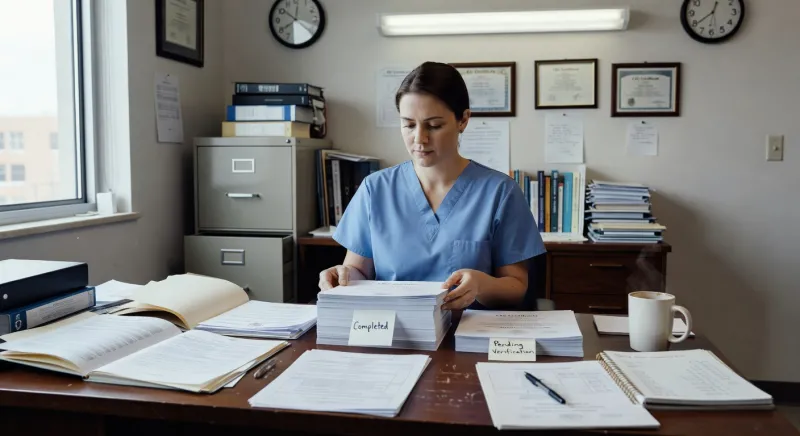
Most nurses know the big milestones: pass the NCLEX, land a role, eventually pursue a specialty certification. But between those landmark achievements, years of meaningful skill-building often go undocumented — invisible to employers and disconnected from any formal record. That's the gap micro-credentials are designed to close. These short, focused, digitally verifiable credentials are quietly becoming one of the most practical tools in nursing professional development, and most nurses haven't fully explored what they offer.
What Exactly Is a Micro-Credential?
A micro-credential is a formal recognition of a specific, narrowly defined competency. Unlike a degree, which takes years, or a full specialty certification, which requires extensive clinical hours and a comprehensive exam, a micro-credential targets one skill or knowledge area — think sepsis management protocols, trauma-informed care communication, or simulation-based education techniques. Completing the required learning and assessment earns you a verifiable digital badge.
Digital badges are more than icons on a profile. Each badge is embedded with metadata: who issued it, what competency it represents, what criteria had to be met, and when it was earned. That information travels with the badge wherever you share it — on LinkedIn, in a digital portfolio, or attached to a job application. An employer or credentialing body can verify it with a click.
As an Amazon Associate, I earn from qualifying purchases.
How the Stackable Model Works
The word "stackable" is key. Individual micro-credentials aren't designed to stand alone forever — they're built to accumulate. Stack enough related badges and they can count toward a larger credential, a continuing education requirement, or even academic credit at participating institutions. Think of it like building blocks: each one has standalone value, but the structure they form together is what creates long-term career momentum.
For nurses, this model makes a great deal of sense. Clinical life is busy. A two-hour focused module on central line-associated bloodstream infection (CLABSI) prevention is far more achievable on a night-shift schedule than enrolling in a semester-long course. Micro-credentialing meets nurses where they are, in terms of both time and learning preference.
Who's Issuing Nursing Micro-Credentials?
Several credible organizations have moved into this space, and the landscape is still developing. Professional associations, academic institutions, and healthcare systems are all exploring different models.
Professional Associations
The National League for Nursing (NLN) has issued digital micro-credentials for nurse educators covering specific competencies such as simulation education. This is a significant signal: when an organization as established as the NLN backs the format, it validates micro-credentials as a legitimate professional currency rather than a passing trend. Nurse educators can now document simulation facilitation skills in a way that's portable, verifiable, and recognized within the academic nursing community.
Other associations across various nursing specialties have begun piloting similar programs. Some are tying micro-credentials directly to continuing education units (CEUs), which gives nurses a practical incentive: earn the badge and satisfy a license renewal requirement at the same time.
Academic Institutions
Many nursing schools and university continuing education programs have launched micro-credentialing programs that can feed into graduate-level pathways. A nurse completing a micro-credential in informatics through a partnering university, for example, might later apply that work toward a graduate certificate or even a master's program. This articulation — where prior learning is formally recognized — is one of the most exciting structural developments in the model.
Healthcare Systems and Employers
Forward-thinking health systems are developing internal micro-credentialing programs tied to institutional competencies. These are particularly common in areas like patient safety, electronic health record proficiency, and specialty unit orientation. While employer-issued badges don't carry the same universal portability as those from independent professional bodies, they create an internal record of competency that can influence staffing decisions, charge nurse eligibility, and preceptor selection.
Why This Matters More Than It Might Seem
The Documentation Problem in Nursing
Nurses develop enormous amounts of expertise informally — through experience, peer learning, and on-the-job problem solving. The challenge is that informal expertise is nearly impossible to communicate on paper. A resume line that says "five years of ICU experience" doesn't distinguish between a nurse who has deeply mastered ventilator weaning protocols and one who hasn't engaged with that skill meaningfully. Micro-credentials create a mechanism to make specific competencies visible in a credible, verifiable way.
The Gap Between Entry-Level and Full Certification
Full specialty certifications require clinical hours that newer nurses simply haven't accumulated yet. The CCRN, for instance, requires 1,750 hours of direct care of acutely or critically ill patients within the two years prior to applying. A nurse two years into an ICU role might be deeply skilled in specific areas but not yet eligible for that certification. Micro-credentials let that nurse document and demonstrate targeted expertise during exactly that developmental window — rather than waiting years to have anything to show for ongoing growth.
Supporting Career Transitions
Nurses who move between specialties or into new roles face a credibility gap. Someone transitioning from medical-surgical nursing into informatics or making a broader career transition into education or leadership may lack formal documentation of their emerging skills. A collection of relevant micro-credentials can bridge that gap, giving a hiring committee or academic program something concrete to evaluate beyond a cover letter claim.
How to Evaluate a Micro-Credential Program
Not all micro-credentials are created equal. Because the space is still maturing, quality varies significantly. Here's what to look for before investing your time.
Issuing Authority Credibility
Who's behind the badge matters. A micro-credential from an established professional nursing organization or accredited academic institution carries genuine weight. One issued by an organization with no recognizable standing in the nursing community may not translate to anything meaningful in the job market. Research the issuer's reputation within your specialty or practice area before committing.
Competency Specificity
The best micro-credentials are precise. A badge for "communication skills" is vague enough to be nearly meaningless. A badge for "motivational interviewing techniques in chronic disease management" tells a specific, credible story. The more specifically a micro-credential defines the competency it represents, the more useful it is as a professional signal.
Assessment Requirements
Legitimate micro-credentials require you to demonstrate competency, not just complete a module. Look for programs that include scenario-based assessments, skill demonstrations, case studies, or proctored evaluations. A credential earned by clicking through slides and passing a multiple-choice quiz is a different — and weaker — signal than one requiring applied demonstration.
Articulation and Portability
Ask directly: Does this badge articulate toward a larger credential? Can it count toward CEUs for license renewal? Is the digital badge issued through a recognized platform — Open Badges infrastructure, Credly, or similar — that supports independent verification? If the issuer can't answer these questions clearly, the credential's long-term value is uncertain.
Practical Steps to Get Started
If you're ready to explore micro-credentialing, a few concrete steps will orient you quickly.
- Identify a skill gap or growth area. Where do you want to build or document competency in the next six to twelve months? That focus will help you evaluate which offerings are actually relevant versus which ones sound interesting but don't serve your goals.
- Check your professional associations. Whatever nursing specialty you practice in, your primary professional organization is the first place to look. Many have launched or are developing micro-credentialing programs specifically designed for their membership.
- Audit your employer's offerings. Ask your nurse educator or professional development department whether your institution has internal credentialing programs. These are often underutilized and may satisfy requirements you already need to meet.
- Build a digital portfolio. Start curating a space — LinkedIn is the most visible option — where badges can be displayed and verified. Employers and recruiters increasingly check these profiles, and a well-organized credential section tells a story your resume can't fully tell.
- Track CEU alignment. As you pursue micro-credentials, document whether they satisfy continuing education requirements for your state license. Efficient professional development means every hour spent serves more than one purpose.
The Bigger Picture
Micro-credentialing isn't a replacement for the deep expertise that comes with full specialty certification, advanced degrees, or years of clinical practice. It's a complement to those pathways — a way to document the continuous, granular skill development that happens throughout a nursing career but has historically left no formal trace. As healthcare systems become more sophisticated in how they evaluate and deploy nursing expertise, the nurses who have built a documented, verifiable record of specific competencies will have a measurable advantage.
The infrastructure for this shift is still being built, which means nurses who engage with it now are positioned at the leading edge rather than scrambling to catch up later. That's a reasonable place to be.
Sources
Every factual claim in this article was independently verified against the following sources:
- NLN Credentialing — nln.org